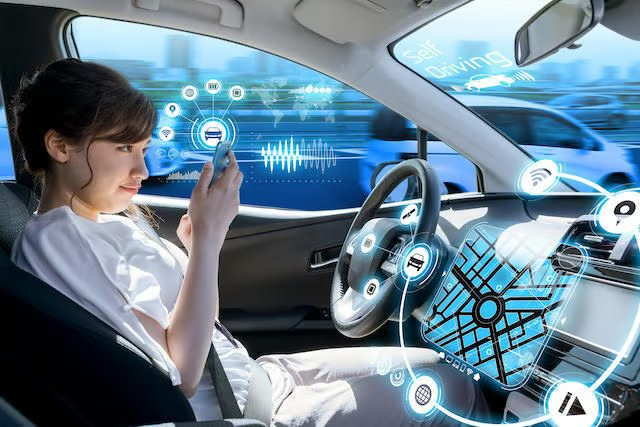
Take a moment and think about your morning routine. You might already use a smart coffee maker, a robot vacuum, or even a self-driving car app to plan your commute. Technology that “does things for us” is no longer science fiction—it’s slowly becoming everyday life. But will autonomous everything really feel normal by 2030?
The Rise of Smart Machines
Over the past decade, automation has jumped from factories to our homes, streets, and offices. AI assistants can schedule meetings, order groceries, or even suggest what to wear. Delivery drones and self-driving trucks are already rolling out in limited areas. By 2030, these machines could handle many tasks we still do manually today.
Convenience Meets Caution
There’s no denying the appeal. Who wouldn’t want a car that drives itself while you catch up on emails? Or a kitchen that cooks meals while you relax? But with convenience comes questions: safety, privacy, and the impact on jobs. Society will need to figure out how to balance trust and control before we let autonomous systems run entirely on autopilot.
Work, Life, and Automation
Jobs that involve repetitive tasks are the first to change. Warehouse work, delivery services, and some administrative roles could be mostly automated. That doesn’t mean humans become obsolete—many new roles will emerge around designing, maintaining, and supervising these systems. The key will be adaptability.
Human Touch Still Matters
Even as machines get smarter, human judgment and empathy can’t be fully replaced. Healthcare, creative work, and relationship-based jobs still need a human touch. By 2030, we might see a world where autonomy is everywhere—but humans are still very much in the loop.
The Road Ahead
Will autonomous everything become normal? Probably, in ways we’re already starting to see. But “normal” won’t mean completely hands-off—it will mean humans and machines working together more than ever. The question isn’t just if machines can do it, but if we’re ready to share our world with them.